Tuning and motorsport demand precision, high-performance components and reliability. Every component of the vehicle, from the engine to the brakes, has to withstand extreme conditions. Among the most important parts of these systems are fittings and hoses, which play a key role in carrying fluids, whether fuel, oil or coolant.
The AN designation...
Tuning and motorsport demand precision, high-performance components and reliability. Every component of the vehicle, from the engine to the brakes, has to withstand extreme conditions. Among the most important parts of these systems are fittings and hoses, which play a key role in carrying fluids, whether fuel, oil or coolant.
The AN designation comes from the phrase Army-Navy. These fluid connection and routing systems were developed during World War II to provide maximum durability in the harshest conditions. They are still used today in everything from aircraft and military equipment to motorsport. The AN size defines the hose diameter and the fitting size, designated AN-2, AN-3, AN-4, AN-6, etc.
AN-3: 3/16 inch (4.8 mm)
AN-4: 4/16 inch (6.4 mm)
AN-6: 6/16 inch (9.5 mm)
AN-8: 8/16 inch (12.7 mm)
AN-10: 10/16 inch (15.9 mm)
AN-12: 12/16 inch (19.1 mm)
AN-16: 16/16 inch (25.4 mm)
AN-20: 20/16 inch (31.8 mm)
Why use AN fittings and hoses?
Fittings provide a high level of reliability because they withstand high pressure and temperatures, which is critical for motorsport applications. Their compatibility also offers modularity, which makes installation and system modifications easier. The fact that they are made of aluminium, steel or stainless steel makes them an ideal component for custom builds too, by welding them onto other parts and then connecting them together. These materials also guarantee high resistance to corrosion. The hoses are protected by multiple layers of stainless steel braiding, which prevents damage, and that is why they are also used by many car manufacturers.
Unlike metric parts, these connections do not seal on the thread or on a flat seating surface. Fittings have a 37° seating surface on the mating pieces, so once tightened, the connection forms a leak-proof joint. For this reason, there is no need to use a copper washer or various thread sealants when installing them.

Types of hoses
Hoses are also sized in AN, depending on the fittings used.
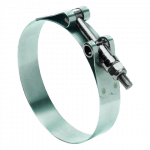
- Rubber hoses - the most common type of hose used in all types of vehicles, mainly for carrying fuel, oil or coolant. Better suited to lower pressures and less aggressive fuels. Over time they may crack and become damaged because there is no braiding to protect them. Suitable for fittings marked "Push Lock" (push-on fitting combined with a standard hose clamp).
- Braided rubber hoses - the same as the rubber hoses above, but with an outer PVC or stainless steel braid that provides maximum protection against mechanical damage. Suitable for fittings marked "Push Lock" (push-on fitting combined with a standard hose clamp) or standard fittings where the hose is crimped between the fitting head and body.
- Teflon hoses (PTFE) - a hose made of durable Teflon, which resists chemicals, oils and aggressive fuels. An ideal solution for top-level motorsport where maximum durability is essential. The Teflon protects the stainless steel braid from external damage. Suitable for fittings marked PTFE, equipped with an aluminium or brass so-called "olive", which is pressed into the hose when the fitting is tightened, preventing the joint from coming loose even at high pressure or temperature.
- Hardline - an aluminium tube resistant to every type of fluid and to high pressure. Also suitable for exterior use, provided the appropriate hardline fittings are installed. In motorsport it is most commonly used for routing fuel, oil or brake fluid. In production vehicles, these tubes are also found in air conditioning lines.

Types of fittings
Fittings are chosen according to the application, together with the need to use a suitable hose.
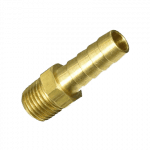
- Push lock - easy to install by pushing on, combined with a hose clamp. Suitable for low-pressure applications. Can be used with rubber hoses.
- Standard fitting - used with braided rubber hoses in AN sizes. Suitable for higher pressure, with easy installation by crimping the hose simply by tightening the fitting head. No special tools or knowledge are required for installation.
- PTFE fitting - the most durable type of fitting, used with a Teflon hose. Suitable for high-pressure installations. The fitting works by pressing the so-called olive into the hose as the fitting head is tightened. This creates a durable joint, which, however, is single-use. To reuse it, you need to buy a new internal crimping "olive".
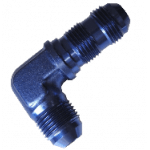
All these fittings are offered in various angles and colours, with the option of connecting them through different fitting couplers or reducers. Every installation has its solution through a combination of fittings and hoses.

How to choose the right size?
The size depends on several factors, such as flow rate, pressure and temperature, as well as the space where the line is being installed.
- Fuel system - AN-6 or AN-8 is often used for fuel flow on high-performance engines. Production vehicles mostly have diameters of 6 to 8 mm, which is equivalent to AN-6.
- Oil system - AN-10 is ideal for oil coolers and the vehicle's lubrication systems. An ideal compromise between size and high flow.
- Cooling system - AN-16 and AN-20 are used for coolant, especially on vehicles built for drifting, where the water radiator is located at the rear.
- Brake system - AN-3 combined with Teflon hoses is the most widely used size on both regular and motorsport cars.
- Clutch system - AN-4, like the brake system, combined with braided Teflon hoses, is a suitable size for the operation of the clutch system.
Special fittings
Fittings also offer the advantage of various external connections to the system, or other benefits that a classic hose connection does not allow.
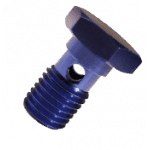
- Sensor connection - fittings that allow a sensor to be connected without disconnecting the system. They also help when there is not enough room at the place where the sensor is needed. You can then connect the sensor at a more distant location using the appropriate fitting.
- Weld-on fittings - if your vehicle does not have an outlet in an AN size, you can use weld-on fittings in three different materials: aluminium, steel and stainless steel.
- Quick-release fittings - used mainly in top-level motorsport. They allow the system to be disconnected in the event of an accident or when replacing the connected component, without needlessly draining the fluid. After disconnection the fitting closes, which prevents fluid leakage, so no topping up or bleeding is necessary.
- Snap-on fittings - new in our range - fittings that allow the fitting body to be disconnected without disconnecting the hose or unscrewing anything. Instant disconnection ensures a quick system swap or replacement with another one, with the option of reconnecting immediately. The connection is sealed perfectly by rubber O-rings.
AN fittings and hoses are irreplaceable for motorsport and applications in extreme conditions. Their modularity, durability and wide range of uses make them an ideal choice for anyone looking for reliable solutions for their vehicle. These systems offer a fast and efficient solution for carrying every type of fluid and air in a vehicle, aircraft or other industry.
If you need advice on choosing the right hose or fitting for your application, do not hesitate to contact us.