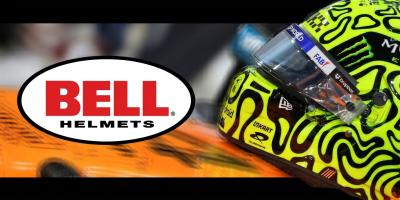
The Bell Racing brand was founded in 1954 and to this day represents the absolute pinnacle of motorsport safety. It was the first in the world to introduce revolutionary innovations such as the full-face helmet and fire-resistant lining, changing driver protection standards forever. Its focus is purely functional: every model is designed for maximum performance, low weight and top-class aerodynamics. The quality speaks for itself. Bell helmets are the choice of most of the Formula 1 grid and of professional rally drivers all over the world. Today the development centre in Bahrain combines hand-crafted production with the latest technology to give drivers protection they can trust even at extreme speeds.
When it comes to safety in motorsport, the name Bell Racing Helmets needs no introduction. For decades they have protected drivers' heads from Formula 1 down to local club racing. If you are about to choose your first (or a new) BELL helmet, you can pick from many types: open face, full face, FIA and HANS ready.
Open Face vs. Full Face helmet
This is the basic question you have to answer first. The choice depends mainly on the type of car you sit in.
Open face helmets (e.g. Bell MAG-10, MAG-1)
- Popular mainly in rally and in closed cars (touring cars).
- Advantages: Better ventilation, wider field of view and easier communication with the co-driver. They are lighter and less restrictive.
- Disadvantages: No chin protection. In an open cockpit (formula cars, karts) they are dangerous because of flying debris and stones.
Full face helmets (e.g. Bell RS7, GP3, GT6)
- A must for circuit racing, formula cars and drivers who want maximum protection.
- Advantages: Maximum structural integrity and face protection. Better aerodynamics at high speed.
- Disadvantages: Higher temperature inside and slightly narrower peripheral vision.

Special features
Shell material
- Carbon models (marked Carbon) are extremely light, which saves your neck under G-forces. Full carbon helmets (e.g. the Carbon or Advanced series) are 150 to 300 grams lighter than composite models. Under 3G in a corner this difference multiplies, which means far less strain on the cervical spine. Carbon fibre is extremely stiff. In a heavy impact (high speed) the shell spreads the energy better over the whole surface, protecting the inner EPS liner. Carbon is ideal for professional racing with high impact speeds.
- Advanced Carbon (FIA 8860): If you are looking for the very best, Bell models with this standard are exclusively carbon. They have 50 % higher penetration resistance and higher energy absorption than standard helmets.
- Composite helmets are more affordable but somewhat heavier. That does not matter in short sprints, but in a 24-hour race or an all-day track day you will feel it. Composite (a mix of glass fibre, Kevlar and resin) is slightly more flexible. Paradoxically, in lower-speed impacts this slight flexibility can be an advantage, because the material itself absorbs part of the energy by deforming.
- Composite/Sport (FIA 8859): Most Bell composite helmets meet this standard, which is perfectly sufficient for most national championships, rally and club circuit racing.
Intercom:
- Male (4 pin): The most common in Bell helmets. Compatible with ZeroNoise, Sparco, OMP and Peltor amplifiers.
- Female: Used when you have a Stilo amplifier in the car. If you want to use a Stilo unit with a Bell helmet, you need either a helmet with a Female connector or an adapter.
- Standard (e.g. MAG Rally): Basic electronics suitable for amateur rally. The microphone has standard noise cancelling.
- Pro / Ultra: Higher earphone sensitivity and a microphone with active noise cancelling. Ideal for loud R5/Rally2 cars where communication is critical.
- Wired-Wireless (WW): The latest technology in top models (e.g. HP10). It allows a wireless link to the car unit via Bluetooth/digital network, so there is no risk of ripping the cable out when getting out of the car.
Interior padding:
- Bell offers cheek pads in various thicknesses for a perfect fit to the shape of your face.
- All liners in FIA-homologated Bell helmets are made of Nomex®. It is a fire-resistant fabric that is mandatory for racing under an FIA licence.
- The material is highly breathable and designed to wick sweat away from the driver's face efficiently. The interior has an antibacterial treatment. Although in many models the whole interior is not fully removable (for safety and a firm bond with the EPS liner), the cheek pads are. For the rest of the padding, special helmet cleaning foams are recommended.
HANS and FIA homologation
Today's Bell helmets are prepared as standard for the HANS / FHR (Frontal Head Restraint) system, which protects your cervical spine in an impact.
- HANS clips: Metal anchors on the sides of the helmet. Many models (marked Hans) have them fitted from the factory.
- M6 Terminals: If the helmet has no clips but has M6 threaded inserts built into the shell, you can buy the clips at any time and fit them easily yourself.
- FIA 8859-2015 - The most common standard for national racing. Club drivers, amateur series.
- FIA 8860-2018 - The strictest standard in the world (Advanced Helmet). Professionals, FIA categories, GT3, F1.
- Snell SA2020 - The American standard focused on impact and fire resistance. Often combined with the FIA standard.

Upgrades
Visors are not just about looks, but about function in changing light conditions. Bell uses DSAF (Double Screen Anti-Fog) technology – a double screen that never fogs up.
- Mirrored and iridium visors: (Blue, silver, red, gold) – They reduce glare and look aggressive.
- Tinted visors: (Dark smoke, Light smoke) – For driving in bright sunshine.
- Amber: Increases contrast in overcast weather or at dusk.
- Graduated: Dark at the top and clear at the bottom – ideal for drivers in cars with a roof who need to see the dashboard in the shade.
Aerodynamic accessories are essential for drivers in open cockpits (formula cars, karts), where the airflow lifts the helmet at high speed.
- Rear Spoilers: Stabilise the helmet and reduce turbulence behind the head.
- Chin Bar Gurneys: Push the front of the helmet down, preventing it from "taking off" at high speed.
- Gurney flaps: Small strips glued to the top of the visor to fine-tune the airflow.
Air Intakes - closed cars (GT, touring cars) get extremely hot inside. Bell offers systems for active fresh air supply.
- Top Air Intakes: Plastic ducts glued to the top vents. They allow a hose from an external fan or a cool-suit unit in the car to be connected.
- Side Air Intakes: Air supply from the side when there is little headroom in the car.
- V-System: Special directional intakes that increase the natural airflow into the helmet even without a fan.
Visor protection (Tear-offs) - thin transparent films stuck onto the visor.
- Use: When the film gets dirty with oil, mud or insects, the driver simply tears it off and instantly has a clear view. Bell offers special kits where up to 10 layers can be applied at once (stackable tear-offs).
Hydration and hygiene
- Drink System: A set of tubes and valves integrated directly into the chin bar of the helmet, connected to a bottle in the car.
- Replaceable padding: The option to change the cheek pads not only for size but also for hygiene after a hard season.
Which helmet to choose?
- Rally: Choose an open face helmet with intercom (e.g. Bell MAG-10 Rally).
- Circuit/Slalom: Choose a full face helmet HANS ready (e.g. Bell GP3 Carbon or RS7).
- Entry budget: Bell Mag-1 or Bell GT6 Sport are a great entry into the world of professional protection.
Do you have questions about a specific product and need advice? Do not hesitate to contact us.