PROFI CONSULTING
from 9am to 5pm



No products
Free shipping! Shipping
0,00 €Total
Product successfully added to your shopping cart
( pcs)
Buy for another and get free shipping
You have free shipping!
 View larger

*336 936
DINITROL 447 is a fast-drying grey protective coating against stone chips and corrosion, based on resin and rubber. Zinc additives increase corrosion protection and, once dry, the protective layer stays elastic and resistant to road salt. Zinc additives for increased corrosion protection, permanently elastic layer resistant to stone chips and road salt, paintable once fully dry.
New product
RS-11024
4046085110247
Add to wishlist In your list · view

DINITROL 447 fast-drying body protection 1 L grey
DINITROL 447 is a fast-drying grey protective coating against stone chips and corrosion, based on resin and rubber. Zinc additives increase corrosion protection and, once dry, the protective layer stays elastic and resistant to road salt. Zinc additives for increased corrosion protection, permanently elastic layer resistant to stone chips and road salt, paintable once fully dry.
Send the question to the owner of the store, about this product.
* Required fields
or Cancel
DINITROL 447 fast-drying body protection 1 L grey
To be informed about product update via email, fill out the form.
* Required
or Cancel
DINITROL 447 is a fast-drying grey protective coating against stone chips and corrosion, based on resin and rubber. Zinc additives increase corrosion protection and, once dry, the protective layer stays elastic and resistant to road salt. Zinc additives for increased corrosion protection, permanently elastic layer resistant to stone chips and road salt, paintable once fully dry.
DINITROL 447 is a fast-drying grey protective coating based on resin and rubber, designed for additional protection of the bodywork against corrosion, stone chip impacts and road salt.
It contains zinc additives that increase corrosion protection. The zinc ions also help prevent or slow down corrosion in places where the protective layer is locally damaged.
Paint over it in the body colour Once thoroughly dry, it can be painted over with standard automotive paints, so the treated area will not be visible.
Does not attack PVC It can also be applied over original PVC underbody coatings without damaging them.
Permanently elastic film The layer stays elastic and does not crack when the body flexes while driving.
No aggressive solvents Contains no chlorinated hydrocarbons, esters or ketones and is free of bitumen and asbestos.
DINITROL 447 is mainly intended for the aftercare of vehicle bodies where an elastic protective layer resistant to mechanical damage and road salt is required. It is used around the wheels, on sills and on the lower parts of the vehicle.
The substrate must be clean, dry and free of corrosion before application. Remove dust, grease, dirt and all poorly adhering layers.
If there is corrosion on the surface, first remove it mechanically and treat residual corrosion in pits with DINITROL RC 900 rust converter.
What you will need
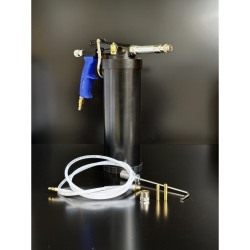
To apply from the 1 litre can, use the UBS gun, and for series work with an adjustable spray pattern, the DINITROL UBS/HR gun. The full range is in the application equipment category.
Check the thickness of the applied coating with a coating thickness gauge.
Cover the surrounding parts with materials from the masking category, wear gloves and eye protection, and keep white spirit at hand for overspray.
Once thoroughly dry, DINITROL 447 can be painted over with most commercially available automotive paints. The manufacturer recommends first testing compatibility with the specific paint system on a small area.
Paintability is exactly what sets 447 apart from bitumen coatings such as DINITROL 4941 / CAR or DINITROL 4942 — these form the final layer and cannot be painted over.
DINITROL 447 is also available in black, 1 L. For smaller spot repairs where you have no gun at hand, choose DINITROL 447 black 500 ml spray.
More materials can be found in the DINITROL stone chip protection category.
Product type stone chip protection
Base resin / rubber
Colour grey
Volume 1 L
Density approx. 1 g/ml
Solids content approx. 50 %
Application temperature 10–25 °C
Application pressure 4–6 bar
Recommended wet film approx. 1000 μm
Film properties permanently elastic
Salt spray test DIN 50021 more than 400 hours
Paintable yes, once thoroughly dry
Overspray removal white spirit
Both are light-coloured and can be painted over. DINITROL 447 is an elastic coating based on resin and rubber with zinc additives that slow down rust even in damaged areas. DINITROL 440 is based on synthetic resin and plastic and also deadens noise, so it is also suitable for the boot and under the bonnet.
From the stone chip protection range, 447, 445 and 440 can be painted over. Bitumen and wax coatings (4941 / CAR, 4942, 482, Metallic) form the final layer and cannot be painted over.
No. The substrate must be clean, dry and free of corrosion. Remove loose rust mechanically and treat residual corrosion in pits with a rust converter.
Wet overspray can be wiped off with a cloth dampened with white spirit. Once dry, it is much harder to remove, so it is better to mask the surroundings beforehand.
This discussion is especially meant for information exchange between customers. For questions regarding your order or stock availability, please contact us directly.





No manufacturer found