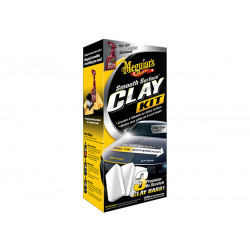
Clay is the easiest and most effective way to remove chemically aggressive contaminants from your paint that regular wash methods can't handle. Fallout, asphalt spots, tree sap, and other aggressive pollutants adhere to the surface of your paint, and if you don't remove them with clay, they will eventually damage your paint, making it impossible to fix without sanding and repainting. With this cost-effective kit and the products it contains, you can easily and effortlessly eliminate chemically aggressive contaminants, leaving your paint as smooth as glass!
Clay is a special type of clay that gently and effortlessly removes chemically aggressive contaminants, known as "contaminants," from the surface of paint, glass, chrome, and most hard surfaces.
Want to know more? Check out our video about this product from Meguiar's:
What is clay used for?
- Clay removes chemically aggressive contaminants (known as "contaminants") that adhere to the surface of the paint and cannot be removed by regular washing or mechanical polishing.
- By using clay, you decontaminate the body surface and achieve a glass-smooth finish.
- A perfectly smooth surface can then be polished better, and wax or other paint protection will last significantly longer on it.
How do I know when it's necessary to use clay?
- After washing and drying the vehicle, run your open hand over the bodywork. If you hear a distinctive shushing sound and feel bumps and irregularities protruding from the paint, it’s time to use clay.
- The roughness of the surface is caused by contaminants adhered to the car body (road dust, brake dust, tree sap, asphalt, etc.). These impurities cannot be removed by regular washing or mechanical polishing. Contaminants bond with your car's paint day after day, week after week, and must be removed before they penetrate the lower layers of the paint, from which they cannot be taken off without repainting.
What imperfections does clay remove?
- road dust
- asphalt spots
- paint overspray
- tree sap
- tar
- old brake dust
- dried insects
- dried bird droppings
- other chemically aggressive impurities that cannot be removed by regular washing
- CLAY does not remove subsurface defects in the paint (scratches, stains, oxidation, holograms, etc. - to address these defects, it is necessary to use one of the Meguiar's polishes)!
How does clay work?
- Clay captures contaminants and gently pulls them from paint and other hard surfaces.
- Decontamination can achieve a surface as smooth as glass.
Will I damage my paint while using clay?
- By following a very simple procedure, you will achieve a dazzling result without damaging the paint!
Is clay abrasive or does it have grinding properties?
- No, clay is not abrasive and has no grinding capabilities. Therefore, it does not weaken the paint in any way, and there is no risk of damaging the surface you are working on.
How often should I use clay?
- There is no fixed interval for using clay. The need for its application depends on many factors (how often you drive the vehicle, where you park, how often you wash the vehicle, etc.). The best way to determine the need for using clay is to run your hand over a clean body surface.
How long will one bar of clay last me?
- The lifespan of each clay bar is limited and depends on its contamination.
- An older clay bar is full of accumulated contaminants it removes from the car's surface. The clay will then be dark and not as soft or smooth to the touch. It is advisable to replace such clay, or clay that has fallen on the ground, for your own interest; otherwise, there is a risk of scratching the paint surface!
Is it necessary to use clay before waxing the vehicle?
- Contaminants on the paint surface prevent it from shining and achieving a perfect reflection of light. If you apply wax to such a dirty surface, you will never achieve the desired results. On the other hand, paint free from all surface contaminants due to clay is ready for finishing treatments with polish and wax, allowing you to achieve maximum results.
What is the best lubricant for use with clay?
- For the best results, use the included A3316 Meguiar's Quik Detailer.
Does CLAY remove the wax layer?
- Yes, clay is designed to remove all surface contaminants while also eliminating any previously applied protective layer. We strongly recommend re-waxing the paint after using clay for maximum protection.
Does clay remove scratches and surface defects from paint?
- No, clay does not remove any subsurface defects in paint.
- Remember that scratches, stains, holograms, and other defects are beneath the surface of the paint. These defects must subsequently be addressed with a suitable Meguiar's polish.
- For best results, it is recommended to first decontaminate the paint with clay (to remove surface, chemically aggressive contaminants) and then use the correct polishes to address paint defects.
How should I store clay?
- Clay should be stored in a clean place. It must also be protected from dust and dirt. The best storage is a plastic container.
The set includes:
G1001 Meguiar's Clay Bar, 3x 60 g
- clay (read as "kley") is a special type of clay that removes everything from your paint that regular washing cannot - asphalt spots, road dust, tree sap, etc.
- After washing and drying, does the paint surface feel rough and not smooth like glass? Then clay is the way to go!
- adequately lubricate the paint surface with the included detailer
- using clay is not demanding - just simply "pet" the surface with the included block and all contaminants are gone!
A3316 Meguiar's Quik Detailer, 473 ml
- lubricant for clay
- also used for regular maintenance of your vehicle - safely removes light dirt and prevents damage to the paint while removing contaminants like fingerprints, dust, smears, and more
- this product also rejuvenates the wax layer on the vehicle and significantly extends the life of the wax protection
X2010 Meguiar's Supreme Shine Microfiber Towel
- high-quality microfiber towel ensures safe and gentle wiping of detailers
- can also be used for polishing or waxing to achieve the best condition of the paint
- the towel is suitable for both the interior and exterior of the vehicle, safe for all metal, plastic, textile, leather, and glass surfaces, both painted and unpainted
- special sealing prevents possible scratching of paint during product polishing
- after each use, the towel can be machine washed
- high-quality microfiber ensures that even after repeated washing, the towel will not lose its softness and fantastic
Application Procedure:
- Form a flat disc with a diameter of about 5 cm from the block of clay.
- Work on an area of bodywork approximately 50 x 50 cm and after processing it, move on to the next area.
- Thoroughly lubricate the paint surface and clay with detailer, wipe the surface dampened with clay.
- During application on the clay network!
- Work with parallel movements approximately 15-20 cm long. First, wipe the entire section in one direction and then wipe the same section perpendicular to the original direction.
- Finally, wipe the entire area dry with a microfiber cloth.
- If some contaminants resist, repeat the process, but never increase pressure on the clay block!
Tips for using clay:
- Always work in the shade and on bodywork that is cool to the touch.
- Never press down on the clay while working!
- If you drop a piece of clay on the ground, do not try to clean it and dispose of it. Clay, upon contact with the ground, collects so many contaminants that it can damage your paint!
- Always adequately moisten the paint and clay with detailer.